How Coastal Communities in India and Beyond Are Restoring Mangroves for Disaster Resilience
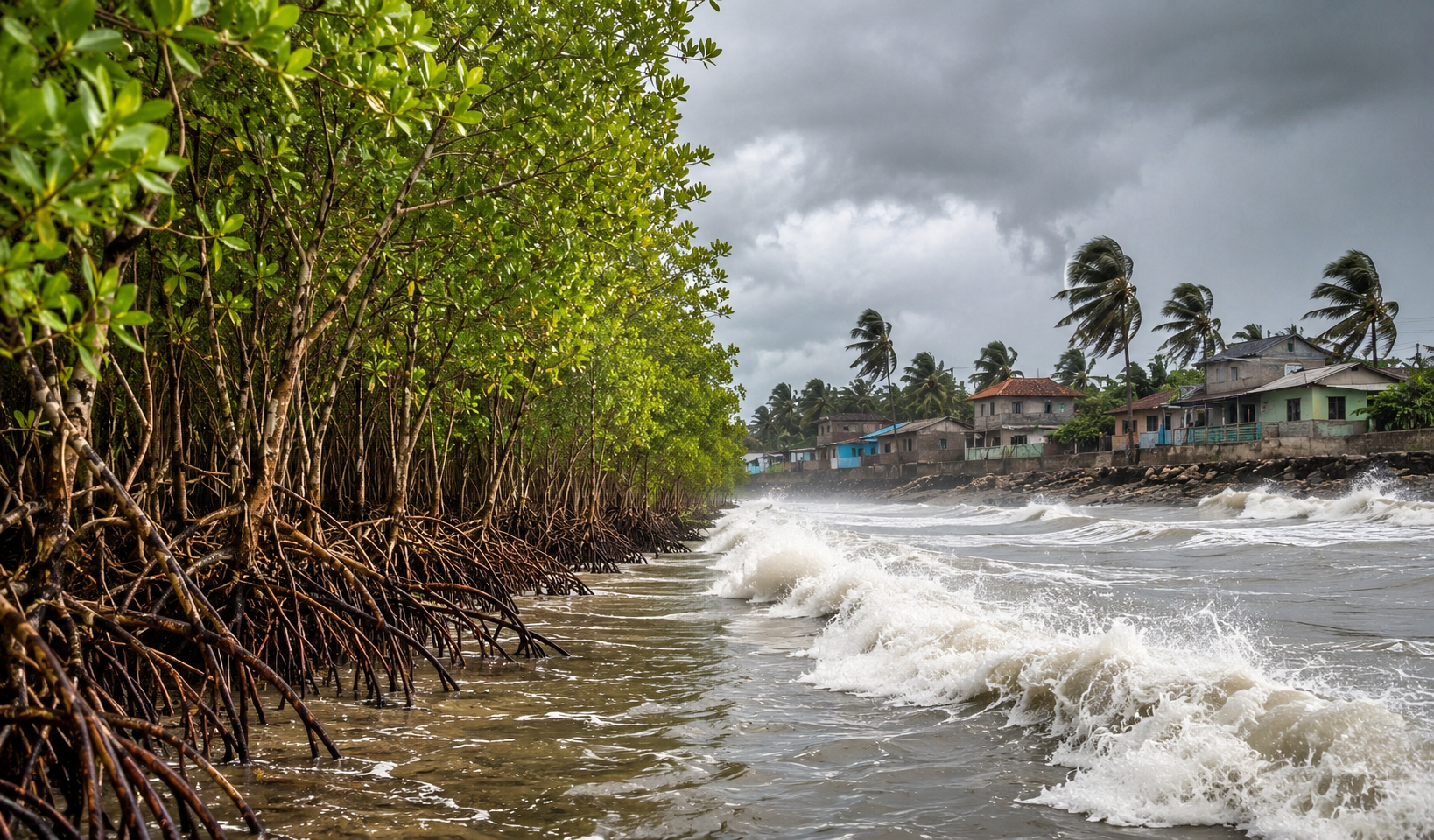
Mangroves are increasingly being recognized as one of the world’s most effective natural defenses against cyclones, storm surges, flooding, and coastal erosion. Stretching across tropical and subtropical coastlines, these salt-tolerant forests protect millions of people while supporting biodiversity, fisheries, and climate adaptation efforts.
In India, particularly in coastal states such as Odisha and West Bengal, mangroves have become central to disaster risk reduction strategies as climate change intensifies tropical cyclones in the Bay of Bengal. Scientific research now confirms that restoring and conserving mangrove ecosystems can significantly reduce cyclone damage, protect livelihoods, and enhance long-term coastal resilience.
According to PreventionWeb, mangrove forests act as natural barriers by reducing wave energy and slowing storm surges before they reach coastal villages. Their dense root systems stabilize sediments and decrease coastal erosion, making them vital buffers during extreme weather events.
Research published in Scientific Reports found that coastal regions with wider mangrove belts and elevated topography experienced significantly lower economic losses during cyclones. The study emphasized that mangroves create “economic safe havens” by reducing direct and indirect storm exposure in vulnerable coastal communities.
Another study highlighted by PreventionWeb demonstrated how advanced modeling techniques can quantify the protective capacity of mangroves. Scientists found that wider mangrove forests are particularly effective in lowering flood intensity and minimizing infrastructure damage during tropical storms.
In eastern India, the Sundarbans mangrove ecosystem remains one of the world’s most important natural coastal defense systems. Covering parts of West Bengal and Bangladesh, the Sundarbans protect millions of residents from cyclones, tidal surges, and salinity intrusion. A report by Down To Earth explains that mangroves significantly reduce flooding and cyclone impacts in Odisha and West Bengal by acting as bio-shields against extreme weather.
Scientific evidence strongly supports these findings. A review published in Climate concluded that mangrove forests reduce flood depths, attenuate waves, and lower storm surge energy in coastal areas. Researchers emphasized that mangroves should be integrated into national climate adaptation and disaster management policies.
Additional studies have shown that mangroves can even reduce wind-related damage during storms. Research conducted using data from the 1999 Odisha Super Cyclone found that mangrove forests helped attenuate cyclone wind intensity and reduced property destruction farther inland.
The role of mangroves in protecting coastlines is gaining global attention as climate change accelerates sea-level rise and increases storm intensity. According to the United Nations Environment Programme (UNEP), rapidly growing coastal cities are now adopting ecosystem-based adaptation approaches that include mangrove restoration as part of broader climate resilience strategies.
Nature-based infrastructure is often more sustainable and cost-effective than relying solely on engineered barriers such as seawalls and concrete embankments. The World Bank has highlighted the importance of combining “green infrastructure” like mangroves with traditional “gray infrastructure” to improve coastal resilience while supporting ecosystems and livelihoods.
Research published in Water found that integrating mangrove belts into coastal protection systems could reduce infrastructure costs by at least 25 percent compared to conventional engineered defenses alone. This demonstrates that mangrove conservation is not only environmentally beneficial but also economically practical.
The recently published article in International Journal of Environment and Climate Change titled “Mangroves and Coastal Topography Create Economic Safe Havens from Tropical Storms” further reinforces the importance of mangrove ecosystems in climate resilience planning. The study explains that mangroves provide measurable protection against storm-related economic losses and can significantly improve disaster preparedness in vulnerable coastal regions. The findings align with global evidence supporting mangrove restoration as a critical adaptation strategy for cyclone-prone coastlines.
Scientists also emphasize that mangroves function as powerful carbon sinks. These forests capture and store “blue carbon” in their soils and biomass at rates significantly higher than many terrestrial forests. By absorbing carbon dioxide and reducing greenhouse gas concentrations, mangroves contribute to climate mitigation while simultaneously protecting coastlines.
However, mangroves themselves face severe threats from coastal development, aquaculture expansion, pollution, deforestation, and rising sea levels. Global mangrove loss has increased coastal vulnerability in many regions, leaving communities more exposed to flooding and cyclone damage. Studies indicate that continued destruction of mangrove ecosystems could significantly increase disaster-related economic losses in the coming decades.
Community participation is proving essential for successful mangrove restoration. Across India, local communities, environmental organizations, and women-led conservation groups are restoring degraded coastal ecosystems. According to Mint Lounge, women conservation leaders in Odisha, the Sundarbans, and Maharashtra are actively protecting mangrove forests while promoting sustainable livelihoods and wetland conservation.
In the Indian Sundarbans, villagers have planted mangroves along embankments to strengthen natural flood barriers following repeated cyclone damage. Restoration projects have shown promising results, with many communities reporting reduced erosion and improved resilience during storms.
Global modeling studies further support mangrove restoration efforts. Research examining storm surge reduction found that mangrove forests can substantially lower flood levels and reduce property damage during hurricanes and cyclones.
As climate change continues to reshape coastlines worldwide, mangroves are becoming indispensable tools for adaptation and disaster preparedness. Their ability to reduce cyclone impacts, support biodiversity, capture carbon, and sustain livelihoods makes them one of the most valuable natural ecosystems on Earth.
Protecting and restoring mangrove forests is no longer simply an environmental concern — it is a critical investment in climate resilience, human safety, and sustainable coastal development.
References
Dasgupta, S., & Blankespoor, B. (2019, April 8). Protection from cyclones: Benefits of integrating green and gray infrastructure. PreventionWeb. https://www.preventionweb.net/quick/23419
Down To Earth. (2024). Mangroves can mitigate cyclones and floods in eastern India, especially Odisha and West Bengal. https://www.downtoearth.org.in/natural-disasters/mangroves-can-mitigate-cyclones-and-floods-in-eastern-india-especially-odisha-and-west-bengal
Livemint. (2024). Women guardians who protect and restore coastal mangrove forests. Mint Lounge. https://www.livemint.com/mint-lounge/ideas/women-guardians-who-protect-restore-coastal-mangrove-forests-odisha-sundarbans-maharashtra-wetland-conservation-11778769717505.html
PreventionWeb. (2020, July 16). Mangroves and coastal protection: A potential triple-win for Bangladesh. https://www.preventionweb.net/news/mangroves-and-coastal-protection-potential-triple-win-bangladesh
SciDev.Net. (2009, April 21). Mangroves protect coastal villages during cyclones. https://www.scidev.net/earth-science/news/mangroves-protect-coastal-villages-during-cyclones.html
United Nations Environment Programme. (2023). The world’s fastest-growing coastal city is bracing itself for climate change. https://www.unep.org/news-and-stories/story/worlds-fastest-growing-coastal-city-bracing-itself-climate-change
World Bank. (2019). Integrating green and gray: Creating next generation infrastructure. World Bank Open Knowledge Repository. https://openknowledge.worldbank.org/entities/publication/49ccb332-7d10-5f50-b739-5ace82e45e37